
We buy Arctic Charr directly from small local aquafarms. Quality assurance is a high priority. Freshness is important for most of our customers. We do our best to meet these requirements. Other customers prefer sending of frozen Arctic Charr. We can help them, as well.
Our company is only making deals with suppliers we know very well and can trust. The farmers – witch all are hands-on – can deliver the very best quality Norwegian fish farmers can do. This is to be able to offer our national and international customers a wide selection of the world’s best Arctic Charr, directly from Norway and even other some few countries.
Laminaria Sales AS is a well-regarded supplier that focuses its sales to the high-end market in Scandinavia and from autumn 2023 in Europe. We are a team player that works together with our customers to find the best solution in each case. Good service and a pleasant tone with both customers and suppliers are normal for our company. Establishing long-term relationships with customers and suppliers is a goal for us. We believe that this usually gives the best results for all parties involved.
About the Arctic Charr
Arctic charr (Salvelinus alpinus), also called char, röding (SE), bleikja (IS), mountain arctic charr (DK) and char(r) (EN) is a fish in the salmon family (Salmonidae).
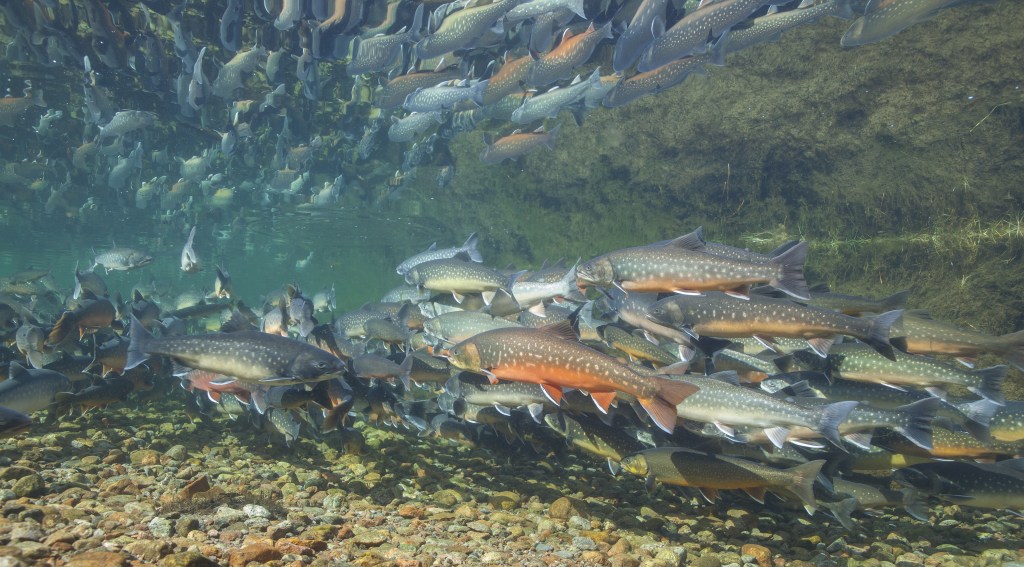
The arctic charr is anadromous, although it is primarily a freshwater fish. In Norway, it is most often divided into two categories; sea char and freshwater char (anadromous vs. stationary), but it is uncertain whether these are genetic variants as a sea char and a freshwater char can be full siblings, mother and daughter or otherwise closely related. Arctic charr that “decide” to migrate to sea undergo a smoltification process and go to sea to graze for 4-8 weeks in the summer, before returning to fresh water. During this time in the salt water it may have multiplied its own body weight. The anadromous charr never goes very far from the coast. Freshwater arctic charr either have no choice to migrate to the se or choose to stay in the watercourse for all or part of their lives. If the char has plenty of space, it creates home areas which it can defend partly aggressively to secure resources. If, on the other hand, char experiences high density, it changes its strategy and switches to swimming in shoals, where it abandons all attempts to defend limited areas.
Look:
Greenish-brown dark back with a silvery belly – this turns red to orange during the spawning season. Abdomen, the tail and anal fins have a white stripe along the edge. Often red or white dots on the sides. The fins are sharper and more prominent than in an arctic charr. The upper jawbone reaches completely behind the back of the eye. The arctic charr usually weighs a couple of kilos, but specimens of up to 20 kg have been caught. It can also be very old in arctic regions, up to 25 years!
Diet:
Arctic charr are primarily carnivorous, but their diet changes throughout the seasons. Lives on other fish up to 1/3 of its own size, fish roe, small crustaceans, zoo plankton and other small organisms it finds on the bottom and water surface. The char can also be cannibalistic if there is a shortage of food and likes to eat another char’s roe. Arctic charr can go a long time without food in the winter, and it is natural that both appetite and combustion/metabolism drop to a minimum during cold periods.
Puberty:
The timing of when the char reaches sexual maturity is both genetically determined and influenced by the environment. Cold water inhibits growth and sexual maturation, while hot water accelerates it. Some char can therefore reach sexual maturity when they are 1 year old, while others do not reach sexual maturity until they are 5-6 years old. Males are often ready faster than females. The male will have a strong red belly and hooked jaw, while the female will only become slightly red as she prioritizes transferring the red colour (which is also a strong antioxidant) down to the roe to ensure survival.
Spawning:
Spawning usually takes place between September and November, depending on the temperature of the watercourse (there are populations with spring spawners, e.g. where lakes almost freeze to the bottom). Arctic charr almost always spawn in still water (lake) and only in fresh water. The bottom must be covered with gravel and pebbles, and char prefer places that are not too deep, but also not so shallow that the risk of predation increases. The female arctic charr searches for a good spot and begins to dig a spawning pit by beating her tail. The males will form territories and fight among themselves for the females. They also prefer to spawn with several females in the same year. The female is attracted by the nice red colour of the male and can be picky in choosing a partner. When a suitable pair has been formed, she spawns the roe in the spawning pit, and the male rushes to cover it with milk. They then bury the roe by slapping their tail again, and the female guards the spawning pit for a while so that the roe is not dug up again or eaten by other fish. The female lays about 3,000 eggs per kilogram of body weight. The arctic charr is a multiple spawner and will not die after spawning as most salmon do. Both the male and the female will eventually morph back to their normal appearance. When the char is sexually mature, it is a poor food fish as the meat quality and colour deteriorates greatly.
The eggs hatch after approx. 515 daily degrees, and the yolk sac chicks move down into the gravel to find support and shelter while they grow. When the fry is ready to start eating, it pull out of the gravel. This happens in the spring, and the young fish remain at their home location until they are 5-7 months old or 15-20 cm long. The arctic charr will always return to its place of birth for its own spawning. Sea arctic charr that are not going to spawn for a season can choose to go up other waterways, then return to their own when they themselves are ready to spawn.

Evolution:
The arctic charr has extreme phenotypic (appearance) plasticity and great genetic variation, and the genetics unfolds in many ways based on individual inheritance and environmental factors. It can take many different appearance types (morphs) such as have different habitat and behaviours and diet, but they can also change morph during their lives to a greater or lesser extent. Siblings can adopt different morphs between them, and the offspring of one morph can adopt a completely different morph when it grows up. The arctic charr is a very exciting species to study as it is in the middle of evolutionary speciation. Some places have different ones.
 Laminaria AS